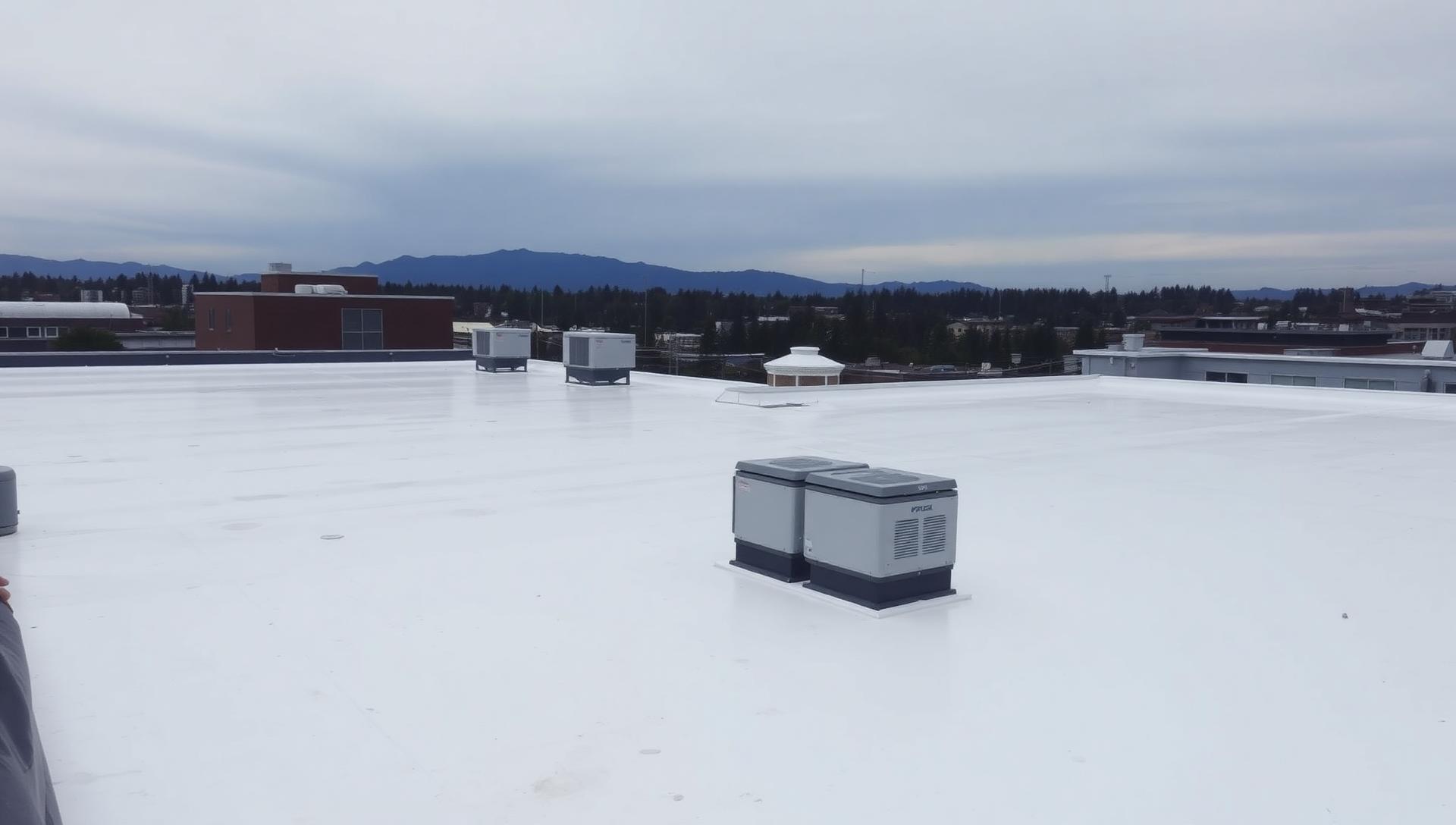
TPO (thermoplastic polyolefin) and PVC (polyvinyl chloride) are the two dominant single-ply membrane systems in the BC strata market. Both are heat-welded, both are white-reflective, both carry 20–25 year manufacturer warranties. From the parking lot, they look identical. The differences emerge over 15+ years of service, in chemical exposure, and in price per square.
Chemistry — the short version
TPO is a polyolefin blend (polypropylene + ethylene-propylene rubber) with no plasticizers. PVC is polyvinyl chloride with plasticizers added to make it flexible. Plasticizers in PVC migrate out over time — that's the source of PVC's well-documented brittleness after 20–25 years. TPO doesn't have plasticizers to lose, but the early formulations (pre-2010) had heat-aging problems that have since been corrected.
Lifespan and warranty
- TPO: 20–25 years observed in BC climate. Manufacturer NDL warranties typically 20 years.
- PVC: 25–30 years observed. Manufacturer NDL warranties typically 25 years. Shorter on roofs with grease exposure (restaurant exhausts).
Chemical resistance
This is the deciding factor for buildings with rooftop equipment. PVC tolerates oils, greases, and most rooftop chemical exposure. TPO does not — even ordinary HVAC compressor oil will degrade TPO seams over time. If your strata has rooftop restaurant exhaust, vehicle fueling adjacent, or heavy mechanical equipment, specify PVC.
Cost
PVC runs roughly 15–25% more per square than TPO at material level. On a typical 100-square strata roof, that's a $4,000–$8,000 premium. Spread over 25 years versus 20, the lifecycle cost is comparable.
Our recommendation
- Standard residential strata, no rooftop restaurants: TPO is the right call. Lower cost, adequate lifespan, well-suited to BC climate. See our TPO membrane service.
- Mixed-use buildings with commercial tenants: PVC, every time.
- Buildings considering future solar: Either is solar-compatible (see our piece on adding solar to a single-ply roof), but PVC handles ballast point loads slightly better.
For a deeper dive on the SBS torch-on alternative, see SBS vs TPO for BC strata. For pricing on your specific building, request a council-ready quote.
Why this matters for BC strata buildings
Most TPO versus PVC single-ply membrane selection guidance you'll find online is written for single-family homeowners in climates that look nothing like coastal British Columbia. Strata corporations operate under a different set of pressures: a fiduciary duty under the Strata Property Act, a contingency reserve fund (CRF) sized against a depreciation report, multiple owners with competing risk tolerances, and an envelope exposed to BC coastal UV, marine salt, and HVAC chemical exposure. A decision that's fine for a Calgary bungalow can quietly cost a Burnaby strata corporation six figures.
This is the same framework we walk councils through during depreciation-report inspections and pre-tender consulting. The goal isn't to scare anyone — it's to make sure which membrane chemistry will hit the 25–30 year service mark is being made with the same data your contractor uses, not a sales pitch dressed up as advice.
The technical anatomy
To understand TPO versus PVC single-ply membrane selection you have to understand the low-slope membrane assembly as a system, not a layer. The visible surface — shingle, membrane, metal panel, or otherwise — is roughly 20% of what determines service life. The other 80% lives below: underlayment chemistry, fastener pattern, substrate moisture content, vapour-control layer position, insulation R-value, drainage slope, and the dozens of flashing transitions where two different materials meet at an angle. The dominant failure mode on BC strata buildings is rarely a defect in the field of the roof. It is almost always specifying the wrong chemistry for the building's exposure profile, and it almost always traces back to a transition detail or an assumption that didn't survive contact with our climate.
The published reference for this work is CRCA Roofing Specifications Manual single-ply chapters. We carry these references on every site and we expect any contractor bidding on strata work to be able to cite them by section. If a contractor pushes back on a CRCA reference or treats a manufacturer specification as optional, that's the single most reliable early-warning sign you'll get.
Where the assembly actually fails
Field failures cluster in predictable locations. After fifteen years of strata-only work across the Lower Mainland, the Fraser Valley, and southern Vancouver Island, the pattern is consistent:
- Perimeter and edge metal — wind uplift concentrates here; this is where the first failures show up after major storms.
- Roof-to-wall transitions — the wall and the roof are usually built by different trades, and the seam between them is where most leaks originate. Our guide on wall and counter-flashing details covers this in depth.
- Penetrations — vents, plumbing stacks, HVAC curbs, and skylights. Any place the membrane or shingle has been cut for something to pass through.
- Drainage components — primary drains, scupper redundancy, gutters, and downspouts. Drainage failure on a BC strata roof usually causes more damage than membrane failure does. See our breakdown in drainage failure on strata roofs.
- Field-level UV and biological exposure — granule loss, moss, algae, and chemical attack from rooftop equipment. Slow, predictable, and the easiest to track year over year.
How BC code and standards apply
The BC Building Code sets the legal minimum. The CRCA Roofing Specifications Manual and RCABC Roofing Practices Manual set the trade standard, and they are both more demanding than code. Manufacturer specifications then layer on top — and where a manufacturer NDL warranty is in play, those specifications become the binding standard for the warranty. Where these three layers conflict, the most stringent always governs. A contractor who builds to code minimum on a strata roof is technically legal and effectively setting the building up for warranty disputes.
The Strata Property Act doesn't specify roofing details, but §72 does specify that the strata corporation must repair and maintain common property — and case law has consistently held that "repair and maintain" means to industry standard, not to the lowest legal minimum. That's the legal reason councils should be specifying CRCA-grade work even when it isn't strictly required by code.
The council decision framework
When TPO versus PVC single-ply membrane selection comes up at a council meeting, the decision usually breaks into four parts. We've watched dozens of councils arrive at the right answer by working through them in this order, and watched just as many arrive at expensive answers by skipping straight to "what does it cost?"
- What's the actual condition today? Get a documented, photo-supported inspection. Not a contractor walk-and-talk — a written report with elevations, dates, and a defect schedule. For most strata buildings this is $18–$28 per square foot installed depending on chemistry and insulation R-value, well worth it.
- What's the realistic remaining service life? The depreciation report number is a planning average. The real number depends on assembly, exposure, maintenance history, and how aggressively the building has been patched. A roofing professional reading the inspection report should be able to give you a 3-year window: "5–8 more years," not "10."
- What are the available paths forward? There are usually three: maintain and monitor, targeted repair, or full replacement. Each has a cost, a risk profile, and a service-life expectation. Lay them out side-by-side. Avoid the temptation to present only the path council prefers.
- What does the CRF and special-levy math look like for each path? This is where most projects live or die at AGM. Owners need to see the cash-flow consequence of each option, not just the headline cost.
Costing ranges and what drives them
For TPO versus PVC single-ply membrane selection, current 2026 BC market pricing sits at $18–$28 per square foot installed depending on chemistry and insulation R-value. The variance inside that range is driven by a handful of factors that are worth understanding before you read any quote:
- Assembly complexity — number of penetrations, transitions, and elevations. A simple rectangular roof costs much less per square foot than a multi-elevation townhome complex with valleys, dormers, and shared walls.
- Access and staging — boom-truck access, scaffold requirements, parking restrictions, and noise-bylaw windows all show up in the price.
- Substrate condition — quoted prices typically assume sound substrate. Allow a 10–20% contingency for substrate repair discovered at tear-off.
- Specification level — base-grade material with manufacturer's standard warranty versus premium assembly with a manufacturer NDL warranty. The price difference is real and so is the warranty difference. See manufacturer NDL warranties for strata.
- Schedule — work scheduled in shoulder season (April or September) typically prices 5–10% better than peak summer.
Risk register: what can go wrong
Every roofing project on a strata building carries a defined set of risks. The good ones are mitigated by specification and contractor selection. The bad ones come from assuming risks don't exist:
- Weather exposure during the work — a partially open roof is the most vulnerable assembly possible. Daily tear-off limits, daily dry-in requirements, and tarp-up procedures should be specified in writing.
- Suite-level damage from interior overflow — the contractor's CGL insurance must extend to consequential interior damage. Verify the certificate before work starts, not after.
- WorkSafeBC compliance and fall-protection — the strata corporation can be drawn into a WorkSafeBC investigation if anchor points or guardrails aren't compliant.
- Warranty documentation gaps — manufacturer NDL warranties require contractor certification, prescribed inspections, and signed-off installation reports. Missing any one of those voids the coverage.
- Permit and bylaw alignment — most BC municipalities require a roof permit on full replacement scope. Phased work crossing calendar years sometimes requires permit re-issue.
What a good specification looks like
A defensible specification for TPO versus PVC single-ply membrane selection reads like a contract, not a brochure. It identifies the manufacturer and product line by name, references the applicable CRCA or RCABC section, defines the underlayment and accessories, names the flashing material and gauge, specifies the fastening pattern, and includes the warranty type the council is paying for. Owners don't need to read every line — but the specification needs to exist in writing before the tender goes out, so all bidders are pricing the same scope. Apples-to-apples comparison is impossible without it.
We provide this specification work as part of every strata reroof tender management engagement. Councils who try to compare bids without a unified specification almost always end up choosing the lowest number, then discovering at month four that the lowest number was for a different scope.
FAQ — what councils actually ask us
How do we know if our existing report is current enough to use?
If your most recent professional inspection is more than 18 months old, treat it as historical context, not current condition. BC weather can move a roof from "good" to "compromised" in a single winter. Get a fresh walk-through before tendering.
Do we have to use the contractor named in the depreciation report?
No. Depreciation reports identify components and timelines, not contractors. The corporation is free to tender any qualified contractor. What matters is that the contractor is licensed, insured, WorkSafeBC compliant, and certified by the manufacturer of the system being installed.
What if owners reject the special levy at AGM?
Council still has a §72 maintenance obligation. The standard response is to commission an interim repair scope, document the rejection in minutes, and re-tender for the next AGM with refined options. Continuing to defer in the face of a documented end-of-life roof creates personal liability for council members.
Is there a way to make this less disruptive to residents?
Yes. Phasing by building or elevation, scheduling around school hours, communicating the daily work plan in advance, and using staging that preserves parking access all reduce friction. We build a resident-communication plan into every project. See our process page for what that looks like.
How long should the work actually take?
Single-building strata roofs typically run 3–10 working days. Multi-building complexes run 4–12 weeks depending on phasing. Anyone quoting dramatically faster timelines is either skipping detailing steps or padding the crew beyond what the building can support.
What to do next
If your council is actively working through TPO versus PVC single-ply membrane selection, the most useful next step is almost always a documented inspection. Without that you're working from estimates of estimates. Once you have a written report, the rest of the process — specification, tender, vote, execution — falls into place in a predictable order. Our team handles all four stages on a fixed-fee or hourly basis.
For the related operational pieces, see our maintenance programs, emergency repair service, and the broader blog index for topic-by-topic deep dives. To get on our 2026 schedule, request a council-ready quote or contact us directly.
Documentation discipline that protects the corporation
One pattern repeats across every successful BC strata roofing project we've delivered: the council that wins the long game is the one that documents obsessively. Photographs with dates and elevation references, written correspondence with the contractor, signed daily-progress logs, copies of WorkSafeBC and CGL insurance certificates, manufacturer registration receipts for warranty activation, and final close-out binders. None of this is glamorous. All of it is what keeps the strata corporation defensible if a defect surfaces in year seven and the contractor has dissolved or the manufacturer questions whether the install met spec.
Our standard close-out package for strata clients includes the signed contract, the as-built specification, the daily field reports, the manufacturer warranty registration confirmation, the WorkSafeBC clearance letter, the post-installation inspection report, and a digital photo library indexed by elevation. We hand the binder to the council president and email a copy to the property manager. Years later, when councils turn over and institutional memory disappears, that binder is what survives — and it's what an insurer or a depreciation-report consultant will ask for first.
Insurance and the role of the strata's own coverage
Strata insurance has tightened dramatically across BC since 2019. Deductibles have climbed, exclusions have expanded, and insurers are increasingly demanding evidence of proactive maintenance before they'll renew at a workable premium. Roofing maintenance records are now one of the documents underwriters request at renewal — particularly for buildings over 25 years old or with prior water-loss claims. A council that can produce annual inspection reports and a documented maintenance program is in a materially better insurance position than one that can't.
This connects directly to the §72 maintenance obligation. The Strata Property Act requires the corporation to repair and maintain common property; the insurance market increasingly requires evidence that the corporation is doing so. The two pressures point in the same direction. Councils sometimes ask whether annual inspections are "really necessary." The honest answer is that they're necessary if you want to defend a claim, defend a depreciation-report assumption, defend a warranty position, and renew insurance at a non-punitive rate. That's four reasons, and any one of them justifies the cost.
The full lifecycle — from new roof to next replacement
A well-installed roof on a BC strata building should be thought of as a 25–40 year asset depending on assembly, with three distinct lifecycle phases:
- Years 1–7: stabilization. Annual inspections, minor adjustments to flashings and sealants, manufacturer warranty registration confirmed and on file. Failures in this period are almost always installation defects and should be pursued under contractor warranty before the workmanship coverage expires.
- Years 8–18: steady maintenance. Annual inspections continue, moss treatment as needed, drain and gutter cleaning twice yearly, replacement of pipe boots and minor flashings as they reach end of life. The roof is performing as designed and the focus shifts to extending service life through small, well-timed interventions.
- Years 19–end of life: managed decline and replacement planning. Inspections increase to twice yearly, the depreciation report assumption gets revisited every three years, and the council begins building specification and tender packages for the eventual replacement. Done well, the actual replacement is a planned event with funding in place — not a crisis.
Skip any of these phases and the building moves into a more expensive lifecycle path. Skip stabilization-era inspections and you miss installer defects until they're out of warranty. Skip mid-life maintenance and the assembly hits end-of-life 5–8 years early. Skip late-life planning and the eventual replacement is funded by an emergency special levy rather than the CRF.
Regional notes across BC
Strata roofs across British Columbia don't all face the same pressures. The same product can deliver 28 years on one building and 18 on another, and the difference is almost always regional climate combined with site exposure. Briefly:
- Lower Mainland (Vancouver, Burnaby, Surrey, Richmond, North Shore): Wet winters, mild summers, persistent moss pressure, aggressive UV in July–August, marine salt influence on waterfront properties. Drainage and biological growth are the dominant maintenance themes.
- Fraser Valley (Langley, Abbotsford, Chilliwack): Slightly less marine influence, slightly colder winters, more snow-load events, more freeze-thaw on shaded north slopes. Ice damming becomes a real concern in higher-elevation pockets.
- Vancouver Island (Victoria, Nanaimo, Comox Valley): Marine salt, dramatic UV on south-facing low-slope roofs, and strong wind-uplift events on exposed properties. Edge-metal detailing matters more here than almost anywhere else in the province.
- Sea-to-Sky and BC Interior: Snow load, ice damming, and freeze-thaw dominate. Steep-slope assemblies and thick ice-and-water shield coverage are not optional.
Specifying a roof to the regional climate — not a generic Canadian average — is one of the highest-leverage decisions the council and contractor will make together. We adjust assembly recommendations city by city across our service area for exactly this reason.
How we work with strata councils
Our engagement model is built around how strata councils actually operate: meetings every 1–3 months, decisions that need owner buy-in, budgets that need to align with the CRF, and timelines that have to respect AGM cycles. We provide written reports council members can read on their own time, attend council meetings to walk through findings, and prepare AGM-ready presentations when a special-levy vote is approaching. We don't pressure-sell, we don't quote on the spot, and we don't ask councils to make decisions in the same meeting they receive the inspection report. See our process page for the full sequence and our team page for credentials.
Service area for this work
We deliver strata roofing services across Metro Vancouver and the Fraser Valley. For city-specific permit, climate, and housing-stock notes relevant to this article, see our pages for Vancouver, Richmond, Burnaby, Surrey. Each city page includes the local building permit office, typical strata housing types, and rainfall data that affects scheduling.
From our network
For more on this topic, see StrataRoofers.com — our knowledge hub focused on strata-titled multi-family roofing across Canada. If you're a council member or property manager, contact us directly or request a council-ready quote.