What AEO is and how it differs from SEO
SEO optimizes for ranked links in a search results page. AEO optimizes for being the source extracted, summarized, or quoted in an answer generated by an LLM or AI overview. The goals overlap, but the techniques diverge in important ways. An SEO-optimized page wins when a user clicks; an AEO-optimized page wins when an answer engine cites it, even if no one clicks.
The shift matters because owner and council research increasingly happens inside AI tools rather than in classic search. A strata president preparing for an AGM types "how much does it cost to re-roof a 40-unit BC townhome complex" into ChatGPT, reads the answer, and arrives at the meeting with a number in mind. The contractor whose content informed that answer has shaped the conversation before the meeting started. The contractor whose content was not extractable has not.
AEO is not a separate discipline from SEO; it is an additional layer that sits on top of strong SEO. Pages that already rank well for traditional queries are the most likely to be ingested by answer engines, but the structure and clarity of the content determines whether the engine will quote them or skim past them.
Lead every section with a direct, declarative answer
The single most effective AEO technique is to write the answer first. Every H2 section should begin with a one or two-sentence direct response to the implicit question in the heading, in plain declarative English, with the key numbers and named entities present. The supporting paragraphs then justify, qualify, and contextualize the answer.
This structure mirrors how extraction algorithms work. An LLM scanning a page for an answer to "how often should a BC strata flat roof be inspected" looks for a sentence pattern like "BC strata flat roofs should be inspected at least once per year, ideally in spring after the wet season, with a documented written report." If that sentence exists in the first 40 words under the relevant heading, it is overwhelmingly likely to be the quoted answer. If the same information is buried in a multi-paragraph discussion that builds toward a conclusion, it is much less likely to be extracted.
The discipline takes practice. Trade writers tend to build context first and arrive at the answer late. AEO inverts the order: answer first, context second.
Structure your content with semantic HTML and FAQ schema
Answer engines parse the DOM. Semantic HTML — proper H1/H2/H3 hierarchy, ordered and unordered lists, definition lists, blockquote for cited material, table elements for comparison data — gives extractors clean handles to grab. Visual styling that fakes headings with bold spans, or builds tables out of div grids, is invisible to the extractor.
FAQ schema (FAQPage JSON-LD) is the highest-leverage AEO addition for a roofing site. Wrap your most-searched council questions in FAQ markup with the question as the entity and the direct answer as the body. The schema both helps Google's classic FAQ rich result and gives LLMs a clean, pre-disambiguated Q&A pair to ingest. The same applies to HowTo schema for procedural content ("How to prepare your strata roof for an atmospheric river") and to Article schema with author and dateModified for editorial content.
None of this changes the visible page. A council member sees the same article. The answer engine sees a structured map.
Cite primary sources by chapter and section
Answer engines weight sources that themselves cite primary sources. A roofing article that says "BC code requires a maintenance plan" is weaker than one that says "Strata Property Act §72 requires the strata corporation to repair and maintain common property, including the roof assembly." The second sentence is more likely to be quoted because it carries its own provenance.
For BC strata roofing content, the primary sources to cite explicitly are the Strata Property Act (by section number), the BC Building Code (by article number and edition), the RCABC Roofing Practices Manual (by chapter and section), CHOA guidance documents (by title and date), WorkSafeBC regulations (by part and section), and the manufacturer technical data sheets for any product recommendation (by document number and revision date). Each citation makes the page more extractable and the contractor more credible.
This is also a quality discipline that has nothing to do with AEO. Contractors who can cite §72 by number tend to be the ones who actually read it.
Visible authorship, review dates, and entity disambiguation
Answer engines rank source trust before they decide what to quote. Three signals dominate: a named human author with verifiable credentials, a recent visible last-reviewed date, and clear entity disambiguation (which company, which city, which jurisdiction). Pages without these signals get skipped in favour of pages that have them, even when the unsigned page is more thorough.
Entity disambiguation matters more in AEO than in SEO. A page about "strata roofing in Langley" should make explicit that it refers to Langley, British Columbia, Canada, not Langley Park, Maryland, USA. The clearest way to do this is structured data — LocalBusiness schema with full address, Place schema with geo coordinates, and explicit city, region, and country properties on every relevant entity. Plain-text mentions help, but schema removes ambiguity entirely.
For councils, this also explains why AI answers sometimes return irrelevant results. The query "strata roof regulations" without geographic anchoring may return Australian or US strata content, which has different governing law. Adding "British Columbia" to the query, or relying on a contractor whose pages are properly disambiguated, materially improves the answer.
The AEO question inventory: build it from real council questions
AEO content should be organized around the questions councils actually ask, not the keywords a tool suggests. The most efficient way to build the question inventory is to capture every question received by phone, email, AGM, and intake form over a 12-month period, deduplicate, and group into themes. The result is typically 60–120 questions across cost, timeline, materials, code, governance, warranty, maintenance, and emergency response.
Each question becomes a candidate H2 or FAQ entry. The high-volume ones get standalone blog posts; the lower-volume ones get FAQ sections on the relevant service or city page. The collective effect is a site that can answer almost any council question with a directly extractable response, which is exactly what answer engines reward.
This also has a side benefit: the same inventory drives intake-form design, sales conversation prep, and team training. AEO ends up being a forcing function for operational clarity.
What AEO does not do — and why content quality still wins
AEO will not rescue weak content. An article that leads every section with a confident wrong answer will be quoted confidently and wrongly, and the source will be discounted as the engine cross-references against more credible material. The technique amplifies whatever is underneath; it does not substitute for genuine expertise.
AEO will also not bypass the EEAT layer. A site without named authors, verifiable credentials, and external citations can do everything else right and still be passed over by quality-conscious extractors. The pillars compound: AEO works best on pages that are already deep, accurate, and credibly authored.
And AEO will not stop owners from arriving at AGMs with confidently wrong AI answers from elsewhere. It will, however, shift the odds. The more BC-specific, council-oriented, properly structured content exists in your contractor's domain, the more likely the AI answer your owner reads will reflect that contractor's actual framing rather than a generic summary written for a Florida HOA.
A practical AEO checklist for any roofing page
- One direct declarative answer in the first 40 words under every H2.
- Numbers, dates, and named entities present in the answer sentence.
- FAQ schema (FAQPage JSON-LD) on every page with a Q&A block.
- Article or BlogPosting schema with author, datePublished, dateModified.
- LocalBusiness or Organization schema with full BC address and credentials.
- Primary-source citations by chapter and section.
- Named author byline with traceable credentials and link to bio.
- Visible last-reviewed date updated honestly.
- Semantic HTML — real headings, lists, tables, no faux markup.
- Clear entity disambiguation (city, region, country) on local content.
What this means for your strata's next AGM
Owners are going to research roofing decisions in AI tools whether the council likes it or not. The question is whether the answers they encounter reflect the BC reality your contractor is delivering or a generic average that does not. AEO is how a contractor makes the former more likely. For councils, the takeaway is to favour contractors whose online content is structured to be quoted accurately by the tools your owners will inevitably use.
To see how we apply these principles across our service pages and case studies, browse our services index or blog index. To get a council-ready proposal that follows the same documentation discipline, request a quote.
How extraction actually works inside an LLM",
Understanding why AEO techniques work requires a brief look at how answer extraction operates. When an LLM or AI overview answers a question, it does so by retrieving a set of candidate sources, ranking them on relevance and trust, and then performing a passage-level extraction or summarization. The passage-level step is where AEO pays off. The engine is looking for a self-contained, declaratively phrased response that minimizes the risk of hallucination if quoted directly. Pages that provide such passages get quoted; pages that bury the answer across multiple paragraphs get skimmed past in favour of a competitor that does not.
The same principle applies to grounding-based systems like Perplexity and Gemini Grounding, which retrieve in real time from the live web. The cleaner and more self-contained the answer passage, the higher the chance it will be the cited source. AEO is essentially the practice of writing for the extractor, not just for the human reader — and the surprising finding is that what works for the extractor also works well for skimming human readers, because both want the answer fast.
FAQ schema implementation, the right way
FAQPage JSON-LD is the highest-yield single AEO addition for a roofing site, but it is frequently implemented incorrectly. The schema should mark up actual question-and-answer content visible on the page, with the question phrased the way a real council member would ask it (not stuffed with keywords), and the answer phrased declaratively in 1–4 sentences. The mainEntity array should contain Question entities, each with a single acceptedAnswer of type Answer. Hidden questions, manipulative phrasing, or answers that link off-page rather than answering inline are quality violations.
One useful pattern: take the top 8–12 questions from your council question inventory, place them in a clearly headed FAQ block on the most relevant service or city page, and mark them up with FAQPage schema. Repeat the pattern across the site with topic-appropriate questions. The compounding effect across a 30-page site is dramatic — both for traditional FAQ rich results and for LLM extraction.
Avoiding hallucination amplification
One AEO pitfall worth naming explicitly: confidently wrong content gets quoted confidently and wrongly. If your AEO writing leads every section with a strong declarative claim, that claim must be correct. Sloppy round numbers, outdated regulatory references, and unchecked pricing ranges will be extracted verbatim and propagated by the engine without the qualifying context that exists elsewhere on your page. The discipline AEO requires is therefore double — clarity in form and rigour in substance. The two together are what produce content that is both quotable and worth quoting.
For BC strata roofing specifically, the highest-risk content categories are cost estimates (which vary widely by assembly, building, and year), regulatory references (which change as the BC Building Code is revised), and product-specific lifespan claims (which depend heavily on installation quality and microclimate). Treat each of these with extra editorial discipline; check the number, cite the regulation by version, and qualify the lifespan with the conditions that produce it.
AEO and the AGM packet
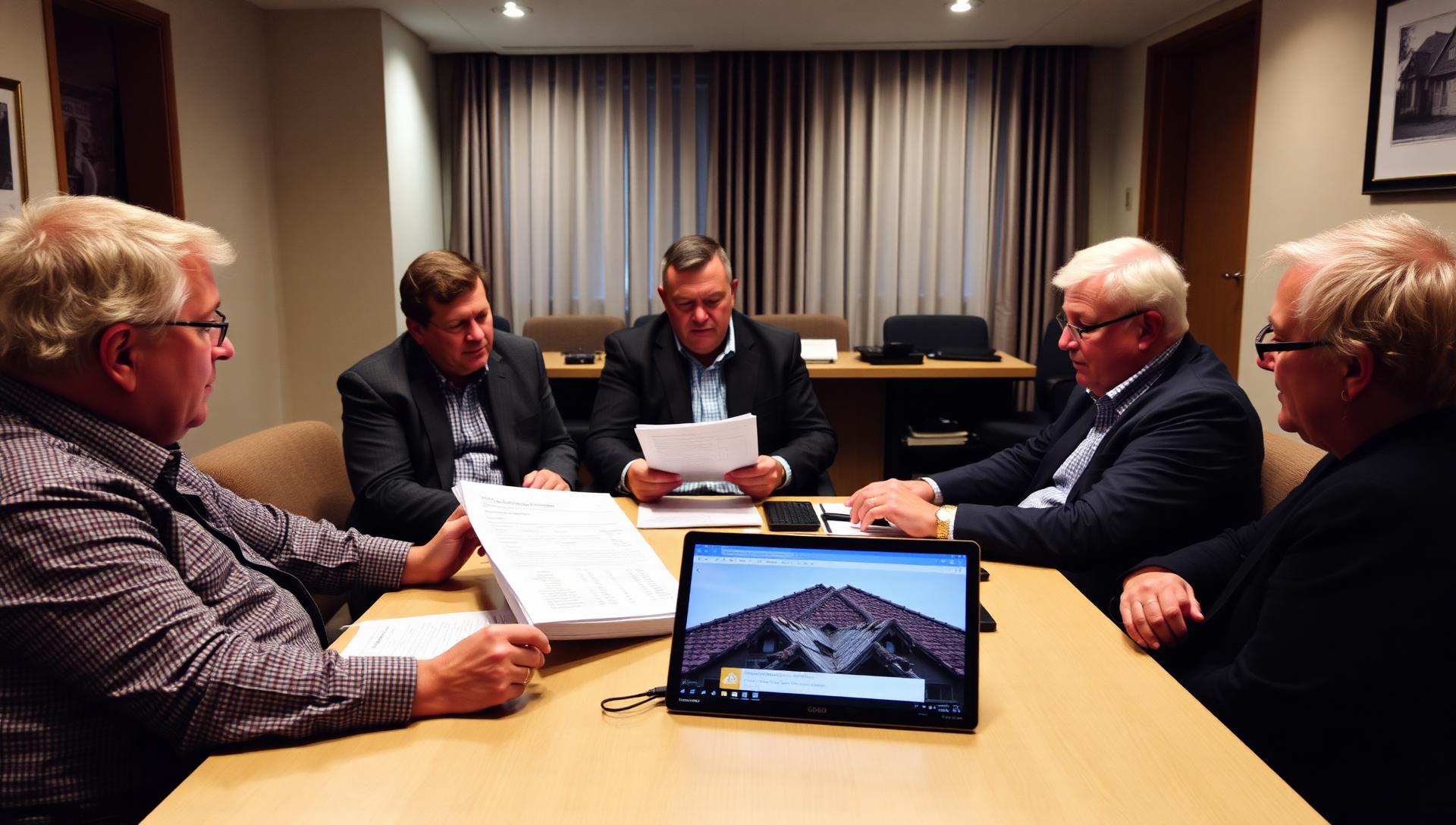
A practical illustration: a strata council preparing an AGM packet on a roof-replacement vote can use AI tools to draft owner-facing FAQs, project summaries, and cost rationales. The quality of those drafts depends entirely on the quality of the underlying source material the engine retrieves. If the contractor's site is well-AEO-optimized, the drafts come out closer to the contractor's actual framing and require only light editing. If the contractor's site is poorly structured, the drafts pull from generic or out-of-jurisdiction sources and require substantial correction.
Councils that work with contractors whose content is AEO-optimized save hours of AGM-prep editing time and produce owner-facing material that better reflects the actual project. Councils that do not are essentially correcting AI-generated misinformation as part of every prep cycle. The cumulative time savings across a multi-year capital project are significant.
The AEO maturity model
Roofing sites can be roughly placed on a four-stage AEO maturity curve. Stage one: no FAQ schema, no structured headings, answers buried in long paragraphs. Stage two: basic FAQ schema on a few pages, some declarative section openers. Stage three: comprehensive FAQ markup, declarative leads under every H2, primary-source citations, named author bylines. Stage four: full AEO discipline plus HowTo schema for procedural content, Speakable schema for voice extraction, structured comparison tables, and ongoing question-inventory updates from real council intake. Most BC roofing sites are at stage one or two. Reaching stage three is achievable in a quarter of focused work; reaching stage four is a multi-year compounding investment.
Final notes for councils and property managers
The disciplines covered in this article are not a one-time checklist; they are a continuous operating standard. Councils that adopt them as a habitual procurement filter make better contractor selections, run smoother capital projects, and produce depreciation reports and close-out documentation that hold up under scrutiny years later. Property managers who internalize the same standards bring more value to every council they serve, because the same evaluation lens that filters roofing contractors also filters mechanical, envelope, and life-safety contractors with very little adaptation.
The single most important habit is to write the standard down. A council with a documented two-page contractor evaluation rubric — covering credentials, experience, EEAT signals, references, insurance, warranty terms, and documentation discipline — runs a fundamentally different procurement process than one relying on informal memory. The rubric does not need to be elaborate. It needs to exist, be applied consistently, and be revisited at every council turnover so institutional memory survives the inevitable changes in council membership.
For our own engagements with strata clients, we provide a sample evaluation rubric on request and walk new councils through how to apply it to any contractor in any trade, not just roofing. The framework is genuinely portable and the multi-trade benefit is one of the larger long-term wins councils can capture from an otherwise narrow roofing decision. To talk through how this applies to your building, contact us directly, browse our services and blog, or request a council-ready quote.
Service area for this work
We deliver strata roofing services across Metro Vancouver and the Fraser Valley. For city-specific permit, climate, and housing-stock notes, see our pages for Vancouver, Burnaby, Richmond, Coquitlam, and the full cities index.
From our network
For more strata-specific roofing analysis, see CHOARoofers.com. If you're a council member or property manager, contact us directly or request a council-ready quote.